

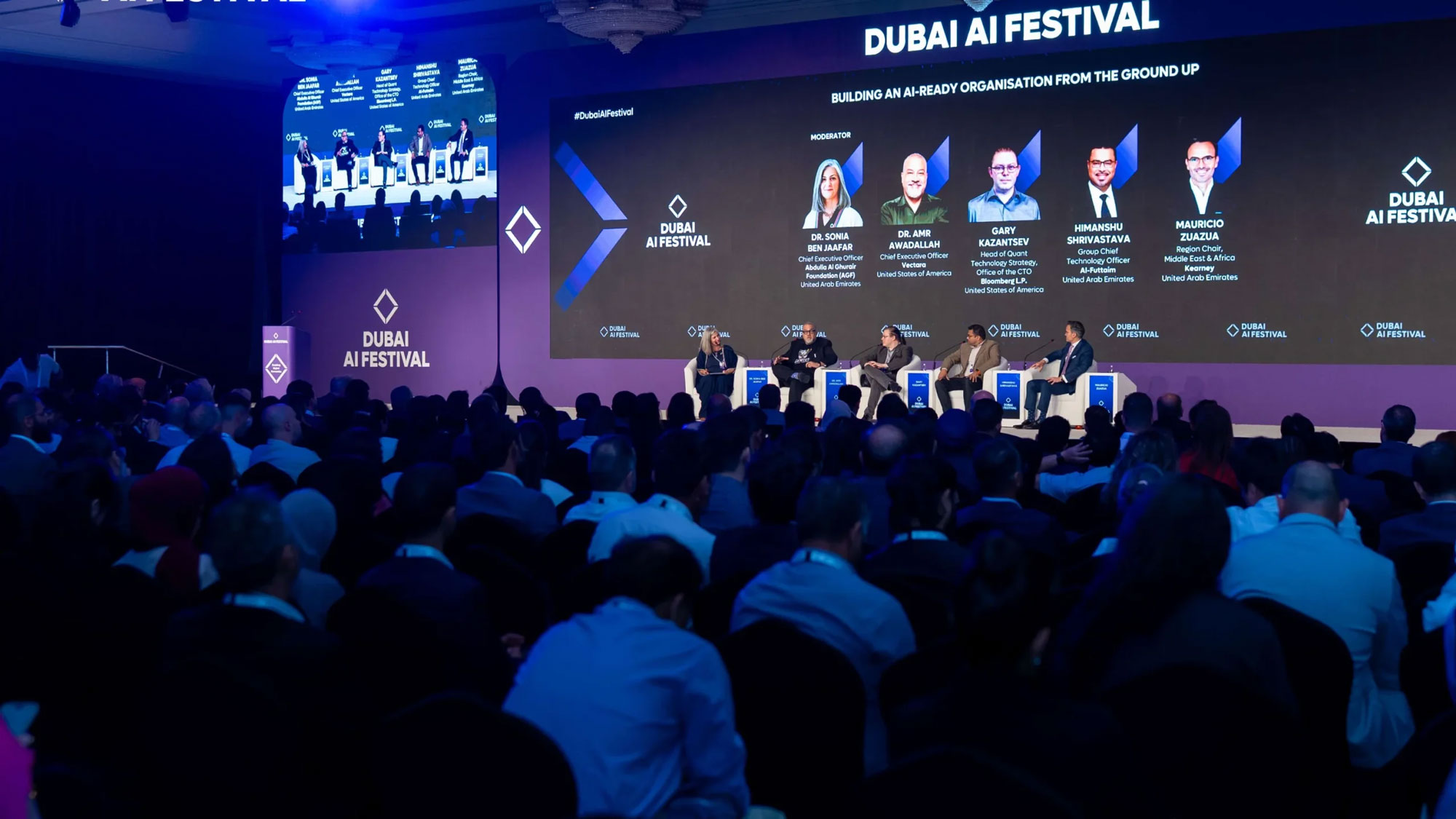
Dubai AI Festival 2026 commenced today at Dubai World Trade Centre as government officials, business leaders, investors and technology companies come together over the next two days to discuss the development, financing, regulation and introduction of artificial intelligence (AI) within their respective industries.
Organised by Dubai AI Campus at Dubai International Financial Centre (DIFC), this year’s event, which runs until tomorrow, marks the festival’s third edition. With over 150 speakers, 500 investors and 200 exhibitors set to take part this time around, the event takes place under the theme Where Intelligence Meets Opportunity.
Alongside the conference sessions taking place on site, more than 50 roundtables and workshops are scheduled over the two-day festival. Some of these cover more specialised topics, while others feature executives from G42, Qualcomm, Emirates Airline and major financial institutions discussing the deployment of AI across their industries.
AI governance is another key topic, with UAE government representatives discussing regulatory oversight, accountability and the use of AI in public services. There’s also plenty happening in the startup and technology sectors, including startup pitches, industry awards and presentations from various technology providers.
To contribute to these discussions, we invited four of Seed Group’s strategic partners — Operavix, Intent HQ, VerbaFlo, and CloudSEK — to share their perspectives on selected topics from the festival’s agenda.
Jump to a section
The session From Human-Driven to AI-First: Leading the Transition to Autonomous and Proactive Business Models will feature Rashid Alabbar, Chairman of Nshama Properties, and Charles Chebli, Qualcomm’s Managing Director for the UAE and Head of AI Cloud.
Moderated by Bloomberg’s UAE Bureau Chief Dana Khraiche, the panel will explore how businesses are adapting their operating models as AI systems become capable of making certain decisions and carrying out tasks with less direct human oversight. This includes assigning responsibilities, redesigning existing workflows and determining accountability for decisions made through automated processes.
Aleksandr Bochkin, CEO and Founder of Operavix, a Seed Group strategic partner specialising in Process Intelligence, shares his perspective on where businesses should begin.
“We are seeing more companies invest in AI, but getting real value from those investments takes more than just technology. The key is context – understanding how work actually happens across an organization, which processes are ready for automation, and which need to be improved first. I believe combining that understanding with AI is how companies can maximize their ROI and move toward AI-native operations.”
— Aleksandr Bochkin, CEO & Founder, Operavix
Another session worth following is How AI Is Re-engineering Banking Operations and Risk. It brings together executives from Mashreq, Zand, HSBC, FABMISR and Network International to examine the use of AI in fraud detection, compliance, core banking systems and risk management.
The panel will also address the difficulties financial institutions face when connecting new AI applications to older infrastructure, particularly where regulatory oversight and customer information are concerned.
For Benjamin Hashim Haas, VP Sales, MEA, at Intent HQ, one issue continues to arise in his conversations with organisations across the UAE:
“In conversations across the UAE, I keep seeing promising AI work slow down at a basic question: who owns the decision it is meant to improve? A bank, telecom operator or retailer may spot a useful opportunity, yet still need agreement on who can act, what the customer should experience and how to tell if it helped. I’d put those questions on the table early, alongside the model and the data. That conversation may be less exciting than another demo, but I suspect it will determine which pilots become part of everyday business.”
— Benjamin Hashim Haas, VP Sales, MEA, Intent HQ
Other sessions will also cover enterprise applications beyond banking, with Atlan and Miral presenting a case study on how to build trusted AI agents using an enterprise context layer, and representatives from APGAR and Alibaba Cloud joining a panel discussion about integrating AI tools into larger business operations.
H.E. Omar Sultan Al Olama, UAE Minister of State for Artificial Intelligence, Digital Economy and Remote Work Applications, will also deliver a keynote speech titled The AI-Native Nation: Turning Vision into National Advantage. In addition, Peng Xiao, Group Chief Executive Officer of G42, will participate in a fireside chat exploring the role of artificial intelligence in supporting national and industrial development across various sectors, including healthcare, education and entrepreneurship.
In another fireside chat, du CEO Fahad Al Hassawi will discuss the importance of building the right digital infrastructure to support the next generation of services. A separate panel discussion with leaders from Invisible Technologies, Relm Insurance and Emirates Airline will explore some of the challenges facing those looking to capitalise on AI breakthroughs, from securing the necessary funding to achieving enterprise adoption when bringing AI-based products to market.
For enterprise buyers, however, many other factors matter. For example, will this technology work with existing systems? How much will it cost to maintain over time? What are the terms of multiyear contracts? These are all critical questions that need to be addressed before making a commitment. There are significant opportunities for technology firms in the UAE, but securing their first major client requires considerable effort. The participation of organisations such as Emirates Airline is particularly relevant to a discussion often dominated by developers and investors.
Beyond the main sessions, the programme also includes:
Sanjog Gupta, Chief Executive Officer of the International Cricket Council, will discuss how AI is changing the experience of cricket fans. Alex Aliper, Co-Founder and President of Insilico Medicine, will present on generative AI in drug discovery and healthcare delivery. H.E. Salem Humaid Al Marri, Director General of the Mohammed Bin Rashid Space Centre, will participate in a discussion on AI and space infrastructure, including intelligent satellites, sensing and secure communications.
Real estate will also be represented, with Nshama Properties participating in the enterprise panel and the Dubai PropTech Hub Annual Awards taking place on the Innovation Stage.
For example, what impact might AI have on property developers’ and operators’ ability to understand residential demand? While rental transactions and occupancy reports are well-established indicators of market activity, property companies also gather valuable information from day-to-day interactions with prospective and existing residents.
Sayantan Biswas, Founder and CEO of VerbaFlo, which recently entered into a strategic partnership with Seed Group to support its expansion in the UAE, shared his perspective:
“For most of its history, residential real estate has read demand through lagging indicators such as transaction volumes, occupancy rates and rent indices, which describe the market only after it has moved. AI shifts the point of measurement upstream, into the thousands of daily conversations residents have with operators about what they want, what they compromise on and why they stay or leave. Each enquiry, maintenance request and renewal discussion becomes evidence of how people actually live, available months before it surfaces in any market report. The developers and operators who learn to interpret this signal will plan buildings around observed resident behaviour, and the gap between what gets built and what people need will begin to close.”
— Sayantan Biswas, Founder and CEO, VerbaFlo
The question is how much we can read into patterns of enquiries and requests from residents. For example, does a surge in maintenance requests at one building suggest some kind of management issue specific to that property?
Or perhaps more importantly, how do we ensure that people interpreting such data don’t make decisions based on misleading conclusions? To inform future developments appropriately, this data needs to be considered alongside other indicators, while ensuring residents’ privacy is protected.
Public-sector applications and issues relating to AI governance form a substantial part of this year’s festival programme. One session, How Governments Are Deploying AI Across Public Services, will see representatives from organisations including DIFC Courts, Google Cloud, Mistral AI and Minerva University sharing their insights into areas such as healthcare, education, justice and government administration, with discussions also covering procurement, collaboration across different agencies and accountability.
H.E. Younus Al Nasser, Chief Executive Officer of the Dubai Data & Statistics Establishment at Digital Dubai, will also participate in a fireside chat on how data and AI can improve decisions affecting cities and society.
The festival will also feature AI Nations, an initiative hosted by Dubai Future Foundation that brings together government leaders and policymakers to discuss national AI strategies, international cooperation and approaches to responsible adoption.
For organisations concerned about control over their AI infrastructure, Mistral AI is organising a closed-door roundtable titled Owning Your AI: What Sovereign AI Actually Means for an Organization and How to Get There. The discussion will examine the technical and financial requirements of maintaining greater control over AI capabilities.
National sovereignty is also the subject of a panel involving representatives from Dubai Police, Dubai Chamber of Digital Economy, Scale AI and Positron AI.
Regulation receives its own discussion in Who Sets the Rules for Global AI Governance?, featuring Dr Marwan Al Zarouni from Dubai’s Department of Economy and Tourism, Ramez Shehadi of Kearney and Mikkel Andersen, Chief Risk Officer at Commercial Bank of Dubai. Cross-border compliance, national standards and differences between regulatory systems are among the scheduled topics.
The security implications are particularly relevant to government institutions, where AI applications may need access to personal records, digital identities and systems supporting essential services.
Public services will need to make sure that those affected by automated decisions understand who they should approach for assistance, including when challenging outcomes or correcting records, particularly where multiple organisations share a common system. Oversight of public services has already been highlighted as a key element in ensuring accountability in this area. Ensuring appropriate protection of the data used by these systems is also crucial.
Gurdip Singh, VP Sales & Partnerships, EMEA & APAC, at Seed Group partner CloudSEK, draws attention to the threats already affecting the public sector:
“Government was among the most targeted sectors in our Middle East threat research, facing both hacktivist disruption and state-linked espionage. As public services adopt AI, citizen data, digital identities and connected systems become increasingly valuable targets. Security must be built into AI infrastructure from the beginning, not added after deployment. Public trust will depend on it.”
— Gurdip Singh, VP Sales & Partnerships, EMEA & APAC, CloudSEK
Don’t forget to share this post!
Join our network for the latest news, announcements and more.

Copyright © 2024 Seed Group. All Rights Reserved.
We use cookies to enhance your experience on our website. If you continue using this website, we assume that you agree with these. Learn more.

 Previous

